
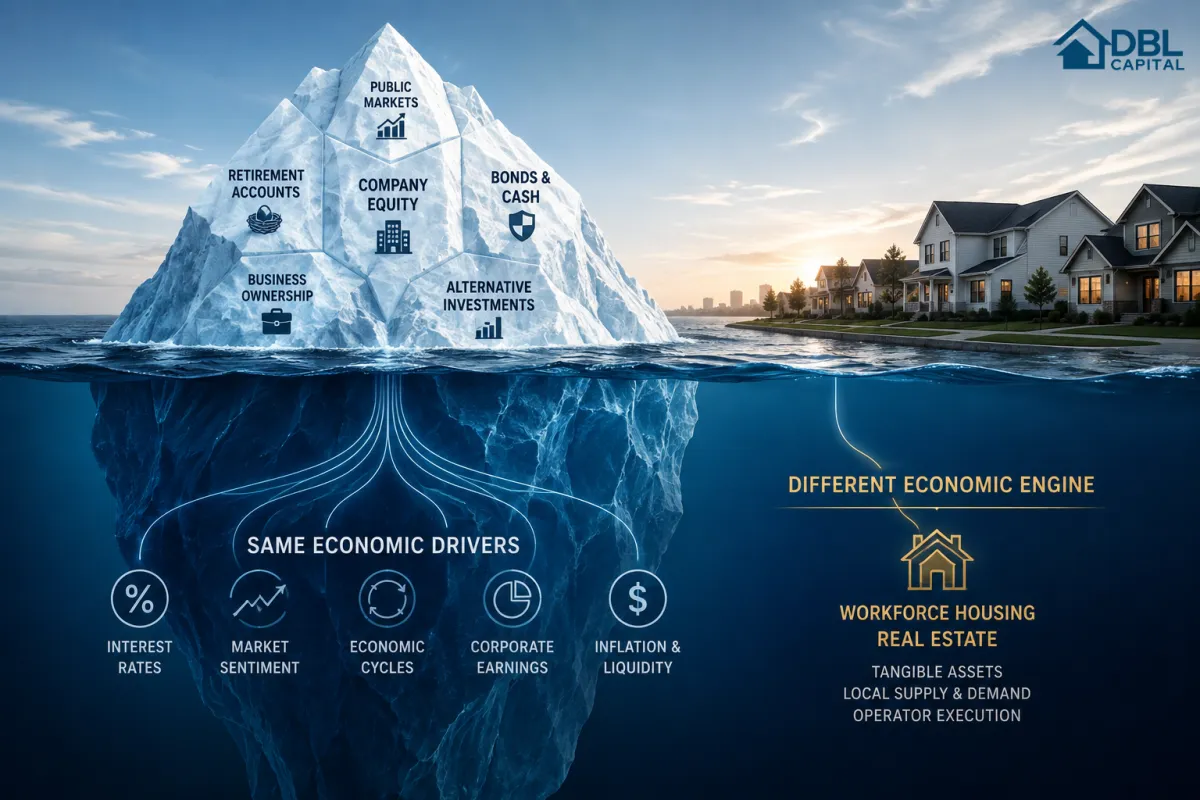
Your Portfolio May Be More Concentrated Than It Looks
A portfolio can contain hundreds of investments and still be more concentrated than it appears.
That's especially true for high-income professionals and business owners. A significant portion of their current income, future earning power, company equity, retirement assets, and investments may ultimately depend on many of the same economic conditions.
The number of holdings isn't the only measure of diversification.
A more useful question is how many different economic engines are supporting your wealth.
For accredited investors who have already accumulated substantial assets, there are three types of concentration worth recognizing.
1. Income Concentration
Specialization is often what creates wealth in the first place.
A physician builds expertise in medicine. An executive advances within an industry. An entrepreneur concentrates time and capital into a business.
The result can be significant earning power, but it also means a large portion of the household's financial future may depend on one primary source.
That becomes particularly important when other assets are connected to the same source. An executive may have salary, bonuses, company stock, and future career opportunities all influenced by the performance of one industry. A business owner may have both current income and a significant portion of net worth tied to one company.
The objective isn't necessarily to reduce exposure to what made you successful.
It's to use the capital that success produces to build wealth outside of it.
2. Market Concentration
Owning hundreds of stocks provides meaningful diversification among companies.
It doesn't necessarily provide diversification away from public markets.
Stocks can still respond collectively to interest rates, liquidity, economic expectations, and investor sentiment. Retirement accounts, brokerage accounts, and equity compensation can look like separate pools of money while sharing many of the same underlying market exposures.
Private investments can introduce different economic drivers.
In real estate, value may be influenced by housing demand, local supply, replacement costs, financing, development basis, and operator execution.
That doesn't make private real estate immune to broader economic conditions or eliminate investment risk. It simply means the capital is being put to work through a different mechanism.
For investors who have accumulated substantial wealth in public markets, that difference can matter.
3. Operational Concentration
This is the form of concentration investors often overlook.
You can diversify your money while concentrating all of the work on yourself.
Owning multiple properties directly may diversify capital across several assets, but the same person may still be responsible for financing, property management, insurance, repairs, capital decisions, and eventual sales.
For a successful professional or business owner, that creates an interesting situation: the person responsible for generating the household's primary income also becomes responsible for operating a growing investment portfolio.
Professional management offers another approach.
A professionally managed fund allows the investor to make the capital-allocation decision while an experienced team handles execution.
That can be particularly valuable in real estate development, where the strategy may require capabilities across land acquisition, financing, construction, project management, and long-term operations.
Diversification Should Introduce Something Different
The purpose of diversification isn't simply to own more things.
It's to reduce the likelihood that the same event affects everything you own in the same way.
That makes the underlying driver of an investment important.
Public equities may depend heavily on corporate earnings and market valuations. A private business may depend on a particular industry or customer base. Real estate introduces exposure to physical assets, local supply and demand, and property-level execution.
Within real estate, workforce housing adds another layer.
Its underlying demand comes from working households who need attainable places to live near the communities where they work—teachers, nurses, first responders, tradespeople, logistics workers, service employees, and other working families.
That demand doesn't make workforce housing immune to economic cycles. But it does give the investment thesis a fundamental economic driver: the need for housing.
For DBL Capital, the strategy combines that demand with the development of new workforce housing. Value creation is therefore tied not only to what happens in the broader real estate market, but also to execution across land acquisition, development, construction, financing, and operations.
The Strategy That Builds Wealth Can Evolve
Concentration is often how wealth gets created.
An entrepreneur builds one company. A physician develops one highly valuable skill set. An executive spends decades advancing through an industry.
As wealth accumulates, the objective can change.
The capital produced by that concentration can increasingly be allocated across investments with different economic drivers, different sources of value creation, and professional teams responsible for execution.
The goal isn't diversification for its own sake.
It's creating a financial future that doesn't require one career, one company, one market, or one person to keep doing all of the work.
DBL Capital's workforce housing fund offers accredited investors professionally managed exposure to private real estate without requiring them to become the developer or operator themselves.
If you're considering whether workforce housing could add a different economic driver to your existing portfolio, we'd be happy to discuss the fund, the strategy behind it, and whether it aligns with your broader investment objectives.
Schedule a conversation with the DBL Capital team:
https://dblcapital.com/investor/call
DBL Capital's fund is available to accredited investors under Regulation D. Private real estate investments involve risk, including potential loss of principal and limited liquidity.


