
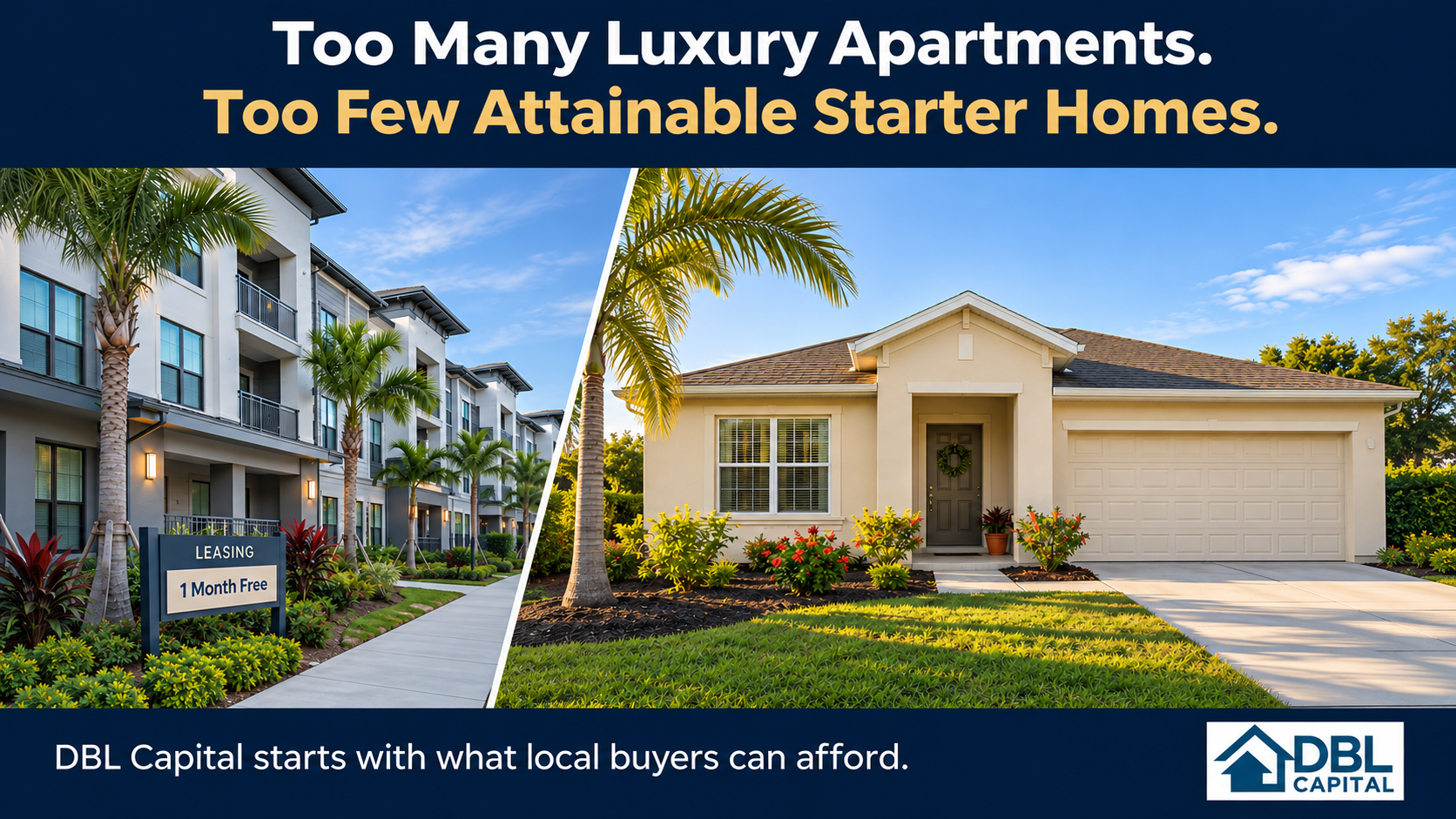
Why Workforce Housing Can Hold Up Better Than Luxury Multifamily When New Supply Floods a Market
When several luxury apartment communities open in the same quarter, the newest building in town can go from having a waiting list to offering two months of free rent. A few miles away, a working family can still struggle to find a starter home it can afford to buy.
That’s the opportunity DBL Capital sees in Southwest Florida. A market can have too much housing at one price and too little at another. DBL starts with what local buyers can afford and uses that number to decide what to build, what to pay for land, and which projects are worth pursuing.
When new supply piles up, advertised rents tell only half the story Class A apartment projects take years to plan and build.
When several open within a few quarters of each other, their owners can end up competing for the same renters at the same time. A free month can help get a lease signed. Offer two months free on a 12-month lease, and a unit advertised at $2,400 a month brings in an average of $2,000 a month over the lease term. The advertised rent can stay at $2,400 while the property collects about 17% less.
Fort Myers has seen that pressure. Lee & Associates reported 16.8% vacancy across the local multifamily market in the third quarter of 2026 and noted that landlords were using free rent and reduced move-in fees to compete for tenants.
A renter already shopping for a luxury apartment might jump at that offer. A household earning $72,000 a year would still face a $200 monthly gap before utilities and fees if it budgeted 30% of gross income for housing. That’s an illustrative budget using a standard measure of housing cost burden. It shows why even a meaningful discount can leave a new unit outside a working household’s price range.
The shortage DBL is building into
Land, construction, and impact fees make attainable starter homes difficult to deliver. That helps explain how a market can have apartment owners competing to fill new units while local buyers still have few homes for sale within reach. The apartment market can soften without creating a single additional starter home for those buyers.
For DBL, the opportunity is to build at a price point where working households have fewer choices. The shortage tells the team where to look. The ability to bring land, construction, and homebuyer financing into one decision is how DBL can act on it.
DBL works backward from what the buyer can finance A buyer shops with a monthly budget.
Mortgage principal and interest, property taxes, homeowners insurance, and any association fees all draw from it. That monthly budget helps establish a realistic purchase price. DBL can then work backward to determine how much the project can support in land and construction costs.
Consider what happens when an attractive parcel would require a selling price above what the intended buyers can finance. DBL can use that information while it still has choices. The team can reassess the land price, revisit the construction plan, or pass on the site. When the buyer’s payment and the development costs line up, DBL has a basis for moving forward at a price it believes local buyers can support.
That timing matters. Once a home is built, a pricing problem can mean accepting a smaller margin or carrying the home longer. By bringing the buyer’s payment into the land and construction decisions, DBL can address that problem while it still has room to change the project.
What that means for investors
The investment case comes down to where DBL can put capital to work. When new supply is concentrated at the high end, DBL can look for starter-home projects with fewer comparable choices for buyers. It can also test whether those projects still work if mortgage rates or insurance costs rise, or if homes take longer to sell.
The shortage creates the opportunity. DBL’s process helps determine which projects can turn that opportunity into homes local buyers can afford. That combination gives investors a concrete reason to look at the strategy when headlines suggest the whole market has too much housing.
If you’d like to see how DBL Capital evaluates a Southwest Florida project from land acquisition through the buyer’s ability to close, schedule a conversation with our investment team. Schedule a conversation with our investment team.


