
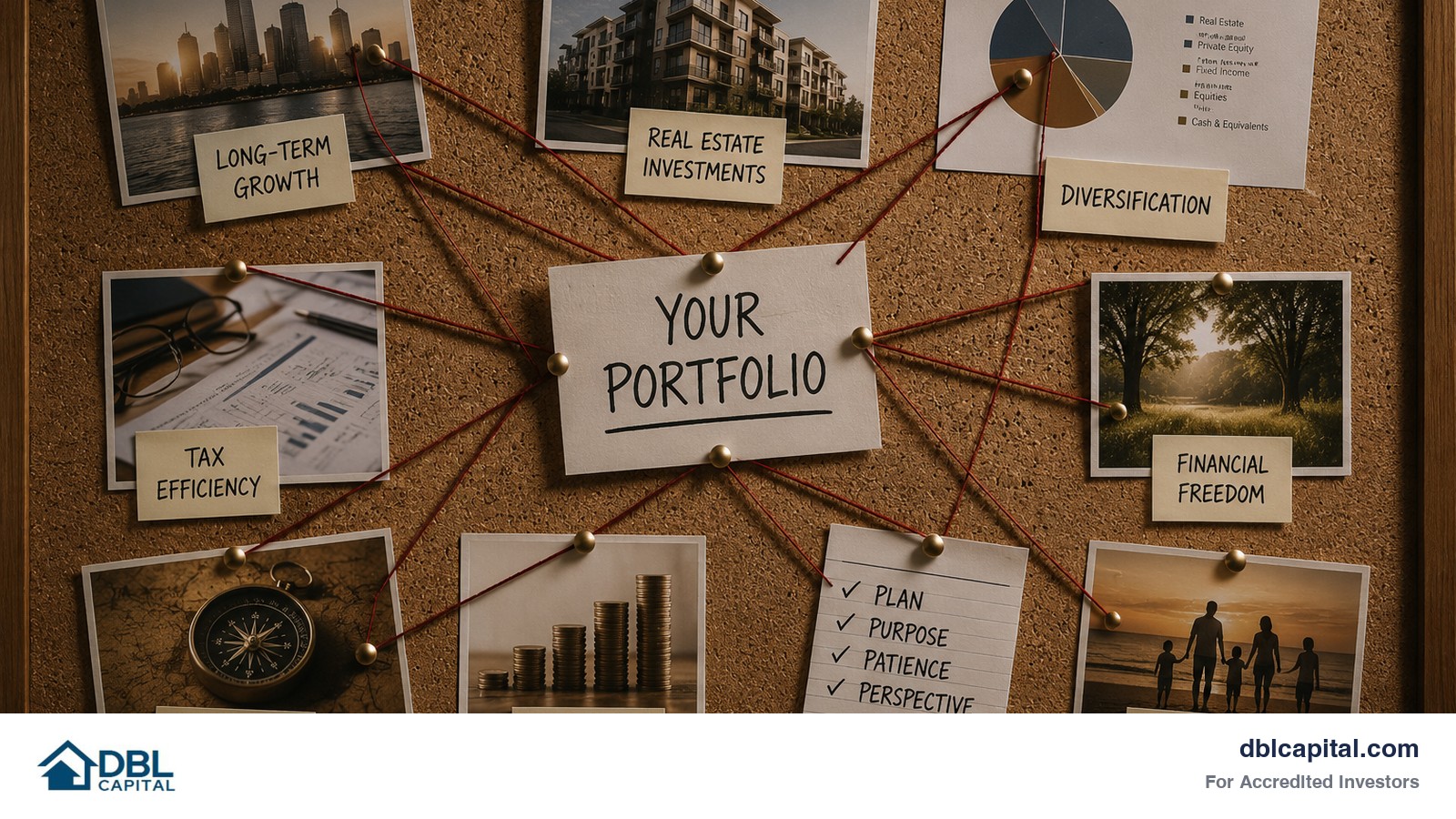
Why Wealthy Investors Think in Portfolios, Not Investments
Most investors evaluate opportunities one at a time.
A stock. A property. A business. A private investment.
Each opportunity is judged on its own merits, often based on projected returns, cash flow, or growth potential.
There's nothing inherently wrong with that approach. But over time, it can create a collection of investments rather than a coordinated wealth strategy.
Portfolio construction is less about finding great investments and more about understanding how different assets work together.
That's where many experienced investors begin to think differently.
The Shift From Individual Investments to Portfolio Design
Every asset brings something different to the table.
Some generate income.
Some provide long-term appreciation.
Some create tax advantages.
Some offer liquidity and flexibility.
Others help reduce concentration risk.
Viewed individually, each investment has strengths and weaknesses.
Viewed collectively, they become part of a larger strategy.
The goal is not to maximize the performance of every single investment.
The goal is to create a portfolio capable of supporting long-term financial objectives through a variety of market conditions.
The Hidden Risk of Success
Many high-income professionals and business owners build significant wealth through a single source.
A business owner may accumulate most of their net worth in one company.
An executive may have substantial exposure to employer stock.
A physician or attorney may rely heavily on income generated from their practice.
Success often creates concentration.
The challenge is that concentration isn't always obvious while things are going well.
A portfolio built intentionally can help create balance by introducing assets that respond differently to economic cycles, industries, and market conditions.
Every Investment Plays a Role
One of the biggest differences between newer and more experienced investors is how they view individual opportunities.
Less experienced investors often focus primarily on potential upside.
More experienced investors tend to focus on purpose.
What role does an asset serve?
Income generation.
Capital preservation.
Tax efficiency.
Diversification.
Long-term growth.
The strongest portfolios are rarely built around a single objective.
They are built around multiple objectives working together.
Building Wealth Is a Process, Not a Collection of Deals
Many investors spend years searching for the next opportunity.
The next property.
The next business venture.
The next investment.
Yet lasting wealth is rarely the result of one exceptional decision.
More often, it comes from a series of disciplined decisions that complement one another over time.
The focus shifts from finding winners to building a structure that can support long-term goals, changing circumstances, and future opportunities.
That's portfolio thinking.
Final Thoughts
A successful investment can certainly create wealth.
A thoughtfully designed portfolio can help preserve it, grow it, and make it more resilient over time.
The difference may seem subtle, but over decades it can have a meaningful impact on outcomes.
For investors exploring how private real estate may fit within a broader wealth strategy, understanding the role an investment plays can be just as important as understanding the investment itself.
If you'd like to discuss how affordable housing investments may fit within your long-term portfolio objectives, schedule a conversation with our team:


