
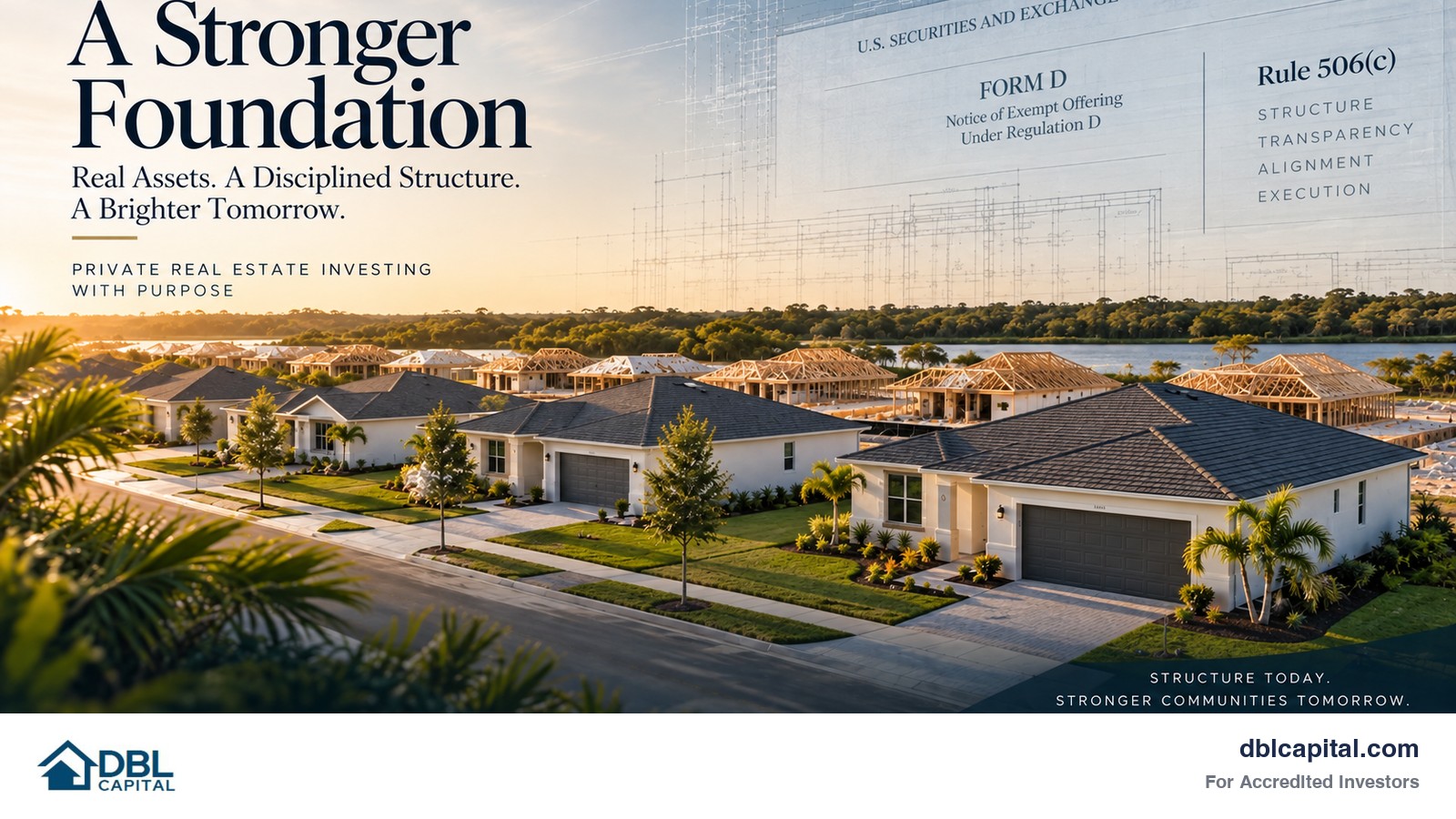
Why SEC Regulation D Matters in a Private Real Estate Fund
When you're considering a significant allocation to private real estate, the properties matter. The strategy matters. The operator matters.
But so does the structure surrounding your capital.
There is a meaningful difference between investing in someone's real estate deal and allocating capital to a professionally structured private real estate fund.
DBL Capital's fund is offered under Regulation D, Rule 506(c), an established federal securities framework for private offerings to accredited investors.
That structure matters.
It establishes rules around how the offering is conducted, who can participate, how investor eligibility is verified, and what regulatory notices must be filed.
But regulation is only the starting point.
For an investor, the more important question is how a professional manager operates within that framework—and whether the structure, strategy, economics, risks, and responsibilities are communicated clearly from the beginning.
Structure Is a Signal
Most experienced private investors understand that a Regulation D offering isn't the same thing as an SEC-registered public security.
The more useful question is what the structure tells you about the investment you're considering.
Under Rule 506(c), every purchaser must be an accredited investor, and the issuer must take reasonable steps to verify that status. The issuer also files a Form D notice with the SEC providing basic information about the issuer and offering.
A Form D filing does not mean the SEC has approved or endorsed the investment. But it does place the offering within a defined federal securities framework.
And that's only one part of what matters.
The offering documents, investment strategy, economics, management team, alignment of interests, and operating platform tell you much more about the investment itself.
For DBL Capital, Regulation D provides the framework around the offering. Our responsibility is what happens within it.
You're Investing in More Than the Assets
This is where fund investing differs significantly from buying a property yourself.
With direct ownership, you make the decisions. You select the property, arrange the financing, oversee the work, manage the asset, and ultimately decide when and how to exit.
A professionally managed fund works differently.
You're allocating capital to a strategy and relying on an experienced manager to execute it across multiple decisions over time.
That can be one of the primary advantages of the structure, particularly for investors who want real estate exposure without adding another operating responsibility to their lives.
But delegation puts more weight on the manager.
For DBL Capital, that means our team is responsible for identifying opportunities, acquiring land, managing development and construction, controlling costs, navigating financing, and executing a strategy focused on creating new single-family workforce housing in Southwest Florida.
The regulatory structure matters because of how the investment is organized.
The operating platform matters because of what happens to the capital after it arrives.
Regulation Doesn't Create Value. Execution Does.
This is an important point.
Regulation D doesn't make an investment successful. A Form D doesn't build a house. Accredited investor verification doesn't create value.
Execution does.
That's why we don't believe investors should evaluate a private fund based on one credential, document, or regulatory filing.
The more complete picture includes the structure of the investment, the experience of the sponsor, alignment between management and investors, transparency around the strategy and economics, and the operator's ability to execute what it says it will do.
This is also where DBL Capital's vertically integrated model becomes important.
Rather than simply allocating investor capital to properties managed by unrelated third parties, our platform is built around executing the workforce housing strategy itself—from acquisition and development through construction and management of the investment process.
Regulation provides the framework.
Professional management puts that framework to work.
The Framework Is Only the Beginning
Operating under Regulation D, Rule 506(c), matters to us.
It places DBL Capital's offering within an established federal securities framework, requires accredited investor verification, and creates formal requirements around how the offering is conducted.
But that's not the investment thesis.
The investment thesis is what DBL Capital does within that structure: deploying capital through an experienced, vertically integrated platform focused on creating new single-family workforce housing in Southwest Florida, where housing affordability and supply remain significant challenges.
For an accredited investor, those two pieces should be considered together.
The structure tells you how the investment is organized.
The operator determines what gets done with your capital.
If you're considering an allocation to private real estate and would like to understand how DBL Capital's fund structure and workforce housing strategy come together, we invite you to have a conversation with our team.


