
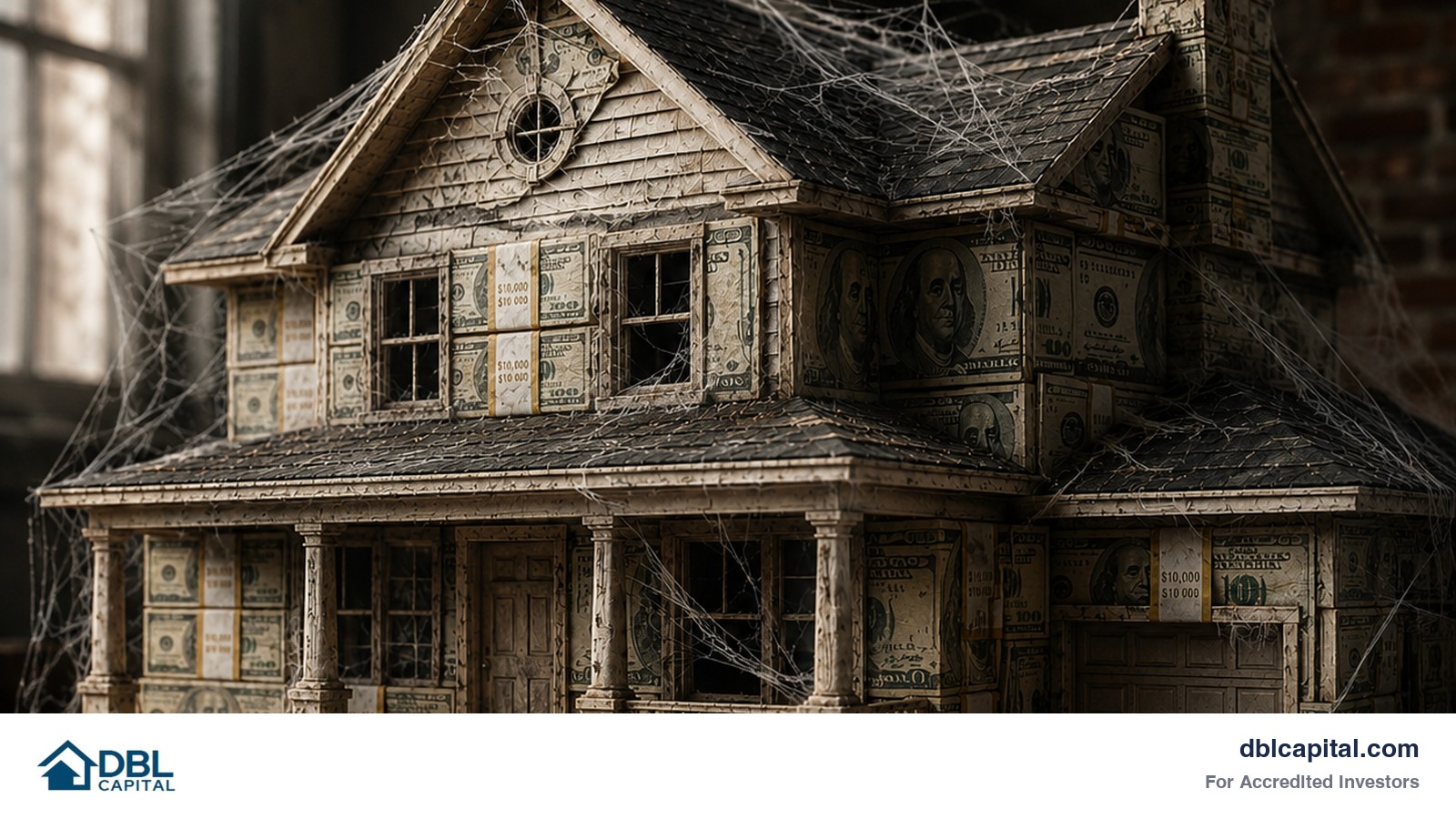
The Cost of Waiting: When Cash Stops Being Conservative
For the last two years, many investors have taken a defensive posture.
Higher interest rates, persistent inflation, volatility in commercial real estate, and uncertainty around the broader economy have pushed significant amounts of capital to the sidelines. According to recent Federal Reserve data, money market fund balances reached record levels in 2024 as investors prioritized liquidity and preservation over deployment.
At first glance, the logic is understandable. Cash offers stability. It reduces exposure to market volatility and creates optionality in uncertain environments.
But there is an important distinction investors often overlook.
Cash may reduce short-term volatility, but it does not eliminate long-term risk.
In many cases, it simply changes the form of the risk being taken.
Why Investors Are Holding Back
Today’s hesitation is not irrational. Many investors are still recalibrating after a decade defined by unusually cheap debt, aggressive asset appreciation, and abundant liquidity.
That environment created a generation of expectations around pricing, returns, and financing conditions that no longer reflect today’s reality.
At the same time, headlines surrounding commercial real estate distress, refinancing pressure, and slowing transaction volume have reinforced the perception that waiting may be the safest course of action.
For affluent investors, especially those with recent liquidity events or elevated taxable income, preserving capital often feels more responsible than deploying it into an uncertain market.
The challenge is that markets rarely become fully “clear” before capital begins moving again.
Historically, periods of opportunity emerge during uncertainty, not after it disappears.
The Opportunity Cost of Staying Idle
One of the least discussed risks in today’s environment is opportunity cost.
While cash yields have improved meaningfully compared to prior years, inflation continues to erode purchasing power over time. More importantly, excessive caution can delay participation in assets that are already repricing around new market realities.
According to JPMorgan Asset Management’s 2025 market outlook, remaining underinvested after periods of market repricing has historically created a larger long-term drag on portfolio performance than short-term volatility itself.
This dynamic is especially relevant in private real estate.
Markets have already adjusted materially from peak valuations. Debt costs are higher. Underwriting assumptions are more conservative. Transaction activity has slowed, but pricing discipline has improved alongside it.
That matters because disciplined markets often create healthier long-term investment conditions than momentum-driven markets.
In speculative environments, rising valuations can mask operational weakness. In more constrained markets, fundamentals become increasingly important. Durable demand, realistic rent assumptions, debt structure, liquidity management, and operational execution all matter more today than they did several years ago.
The focus shifts from appreciation alone to asset quality and sponsor discipline.
For long-term investors, that shift may ultimately prove constructive.
Why Durable Housing Demand Still Matters
Despite broader market uncertainty, one trend has remained remarkably consistent: the structural shortage of affordable housing across the United States.
According to the National Low Income Housing Coalition, the U.S. continues to face a significant shortage of affordable and workforce housing units relative to demand. At the same time, elevated construction costs and tighter lending standards have reduced new development activity in many markets.
This creates an important distinction within real estate.
Not all asset classes respond equally to economic pressure.
Properties tied to durable, necessity-based demand tend to behave differently than assets dependent on discretionary consumer spending or speculative growth assumptions.
That does not eliminate risk. No investment structure does.
But it reinforces why many experienced investors continue prioritizing sectors supported by long-term demographic and housing fundamentals instead of short-term market sentiment.
The Market Has Changed. Investor Discipline Must Change With It.
The current market environment is not a repeat of 2021. Investors waiting for a return to ultra-low interest rates and easy appreciation may be waiting for conditions that are unlikely to reappear in the same form.
That does not mean opportunity has disappeared.
It means investment discipline matters more again.
The investors likely to perform best in this cycle may not be the ones chasing perfect timing. More often, they will be the investors focused on strong operators, conservative underwriting, durable demand, liquidity management, and long-term holding power.
In uncertain markets, patience is valuable.
But indefinite hesitation carries its own cost.
Cash can preserve flexibility, but long-term wealth is generally built through disciplined ownership of durable assets over time, not through waiting for uncertainty to fully disappear.
Historically, it never does.
For investors evaluating where private real estate fits into their portfolio this year, thoughtful allocation decisions matter more than perfect market timing.
If you would like to discuss market conditions, investment strategy, or how affordable housing fits into today’s environment, schedule a conversation with our team here:
_________________________________________________________________________
The Bottom Line
Holding cash may feel conservative in uncertain markets, but long-term investors should recognize that waiting carries its own risks. Markets rarely offer complete clarity before opportunity begins returning.
Today’s environment is not rewarding aggressive speculation, but it is creating opportunities for disciplined investors focused on durable demand, strong operators, and long-term fundamentals.
In many cases, the greatest risk is not volatility itself. It is remaining indefinitely sidelined while markets quietly adapt around you.


