
Is Affordable Housing a Good Investment? What the Data Says About a Long-Term Opportunity
Yes. Affordable single-family housing has become one of the strongest long-term investment themes in real estate.
Not because every affordable housing project is a good investment.
Not because it's protected from changing markets.
But because the demand for attainable housing continues to grow while affordability continues moving in the opposite direction.
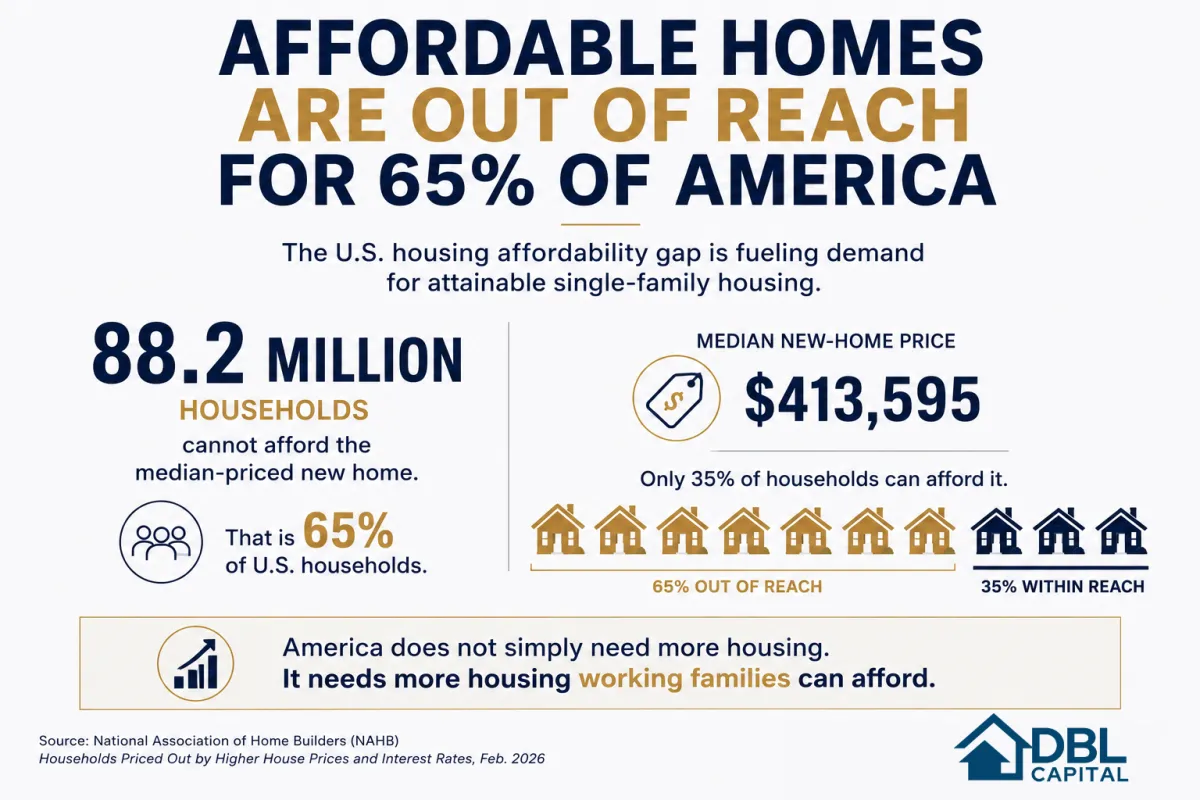
According to the National Association of Home Builders, approximately 88.2 million U.S. households, or 65% of the country, cannot afford the median-priced new home.
That isn't simply a housing statistic.
It helps explain why affordable housing has become an increasingly important focus for private investors, institutional capital, developers, and communities across the country.
At DBL Capital, we look at affordable single-family housing through this lens — not as a trend, but as a gap in the market we're actively building to close.
When evaluating any investment, it's easy to get caught up in market cycles, interest rates, or the latest headlines.
The strongest investment opportunities rarely depend on what's happening this quarter.
They are supported by needs that continue regardless of economic conditions.
Infrastructure supports growing communities.
Healthcare serves an aging population.
Data centers power an increasingly digital economy.
These sectors continue attracting institutional capital because the underlying demand is rooted in necessity, not popularity.
Affordable housing is increasingly being viewed through the same lens.
Affordability Is Reshaping the Housing Market
Housing has always been about supply and demand.
Today, affordability has become just as important.
The median price of a new home in the United States is approximately $413,595. According to the National Association of Home Builders, only 35% of American households can afford a home at that price.
That means nearly two out of every three households are priced out before they ever begin shopping.
Demand for housing hasn't disappeared.
The ability to afford it has.
That distinction is changing how millions of families approach housing decisions.
Some delay purchasing a home.
Some continue renting longer than expected.
Others search for newly built homes at price points that have become increasingly difficult to find.
The need remains the same.
The options have changed.
Why Investors Are Paying Attention
Every successful investment begins with understanding who needs the product.
Affordable single-family housing serves one of the largest and most underserved segments of today's housing market.
These are teachers, nurses, first responders, tradespeople, young families, and working professionals who earn too much to qualify for traditional housing assistance but too little to comfortably purchase many newly built homes.
This is not a niche market.
It represents millions of households looking for quality homes at attainable price points.
As affordability continues to shape housing decisions, demand for attainable housing is likely to remain a defining characteristic of the market.
That is one reason affordable housing has become an increasingly attractive investment theme.
Long-Term Investing Starts With Long-Term Demand
Every investment carries risk.
Market conditions change.
Interest rates change.
Construction costs change.
None of those factors should be ignored.
But long-term investors also recognize that some forces persist regardless of where we are in the economic cycle.
Housing affordability is one of those forces.
It took years for affordability challenges to develop, and they will not be solved overnight.
Construction takes time.
Land takes time.
Entitlements take time.
Closing the affordability gap will take time.
For investors, that matters.
The longer a fundamental imbalance exists, the more important it becomes to understand how that imbalance shapes future demand.
The Opportunity Is Bigger Than the Headlines
The affordability challenge facing U.S. housing wasn't created by one administration, one interest rate decision, or one economic cycle.
It built up over years — and it won't resolve overnight.
For investors, that means affordable housing isn't reacting to today's market. It's responding to a long-term need that continues to grow.
It's part of why we're building at this price point ourselves — reflecting the strategy behind our current development.
So, Is Affordable Housing a Good Investment?
For investors looking beyond the next quarter, we believe the answer is yes.
Not because affordable housing is immune to risk.
Not because every project will succeed.
But because the need for attainable housing is supported by long-term economic realities rather than short-term market sentiment.
When approximately 88 million households cannot afford the median-priced new home, affordability becomes more than a housing issue.
It becomes an investment theme.
For investors evaluating private real estate, understanding the fundamentals behind affordable single-family housing is often more valuable than trying to predict the next interest rate move or market cycle.
If you're considering affordable housing as part of your investment strategy and want to discuss how these trends translate into real-world investment opportunities, schedule an investor call. We'd be happy to share our perspective, answer your questions, and walk you through our approach.
Schedule an Investor Call: https://dblcapital.com/investor/call


